FLAGSHIP COMPUTATIONAL EXPERIMENT · WORKING PAPER · JULY 2026
Standardize the Record, Not the Reader
Decision Records for Consumer AI Agent Markets
Erik Postnieks · Center for Decision Accounting · Working paper
This study reproduces the Calvano et al. algorithmic-pricing environment, instruments every agent decision with a structured pre-decisional record, and separates three mechanisms that are often conflated: filing a record, pricing its welfare consequence into reward, and letting an authorized reader impose a consequence.
A record becomes a control when a reader can attach a consequence.
The outcome measure is the profit-normalized collusion index: values near 1 indicate monopoly-level profit and values near 0 indicate competitive-benchmark profit. All headline estimates use saved treatment cells from 200 deterministic-seed sessions per main cell.
0.816
NO-OVERSIGHT BASELINE
The reproduced pricing agents learn a strongly collusive outcome without any collusive instruction or communication.
0.830 / 0.823
RECORD-FILING ARMS
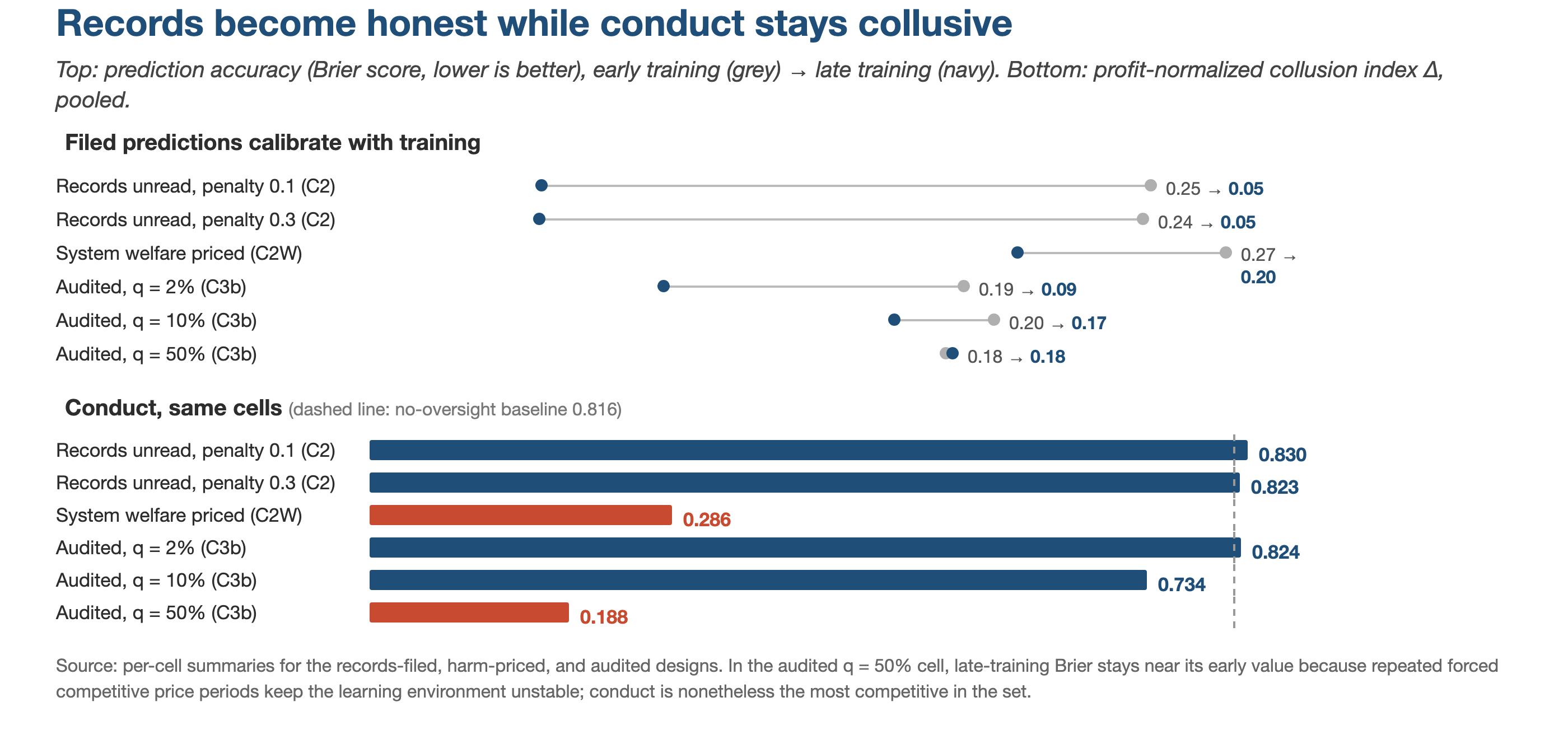
Complete records and scored forecasts leave learned pricing conduct near baseline when no reader can act on the record.
0.286
WELFARE-PRICED REWARD
Conduct changes when the system-welfare component enters the agent's private payoff directly.
25%–50%
HIGH-EXPOSURE AUDITS
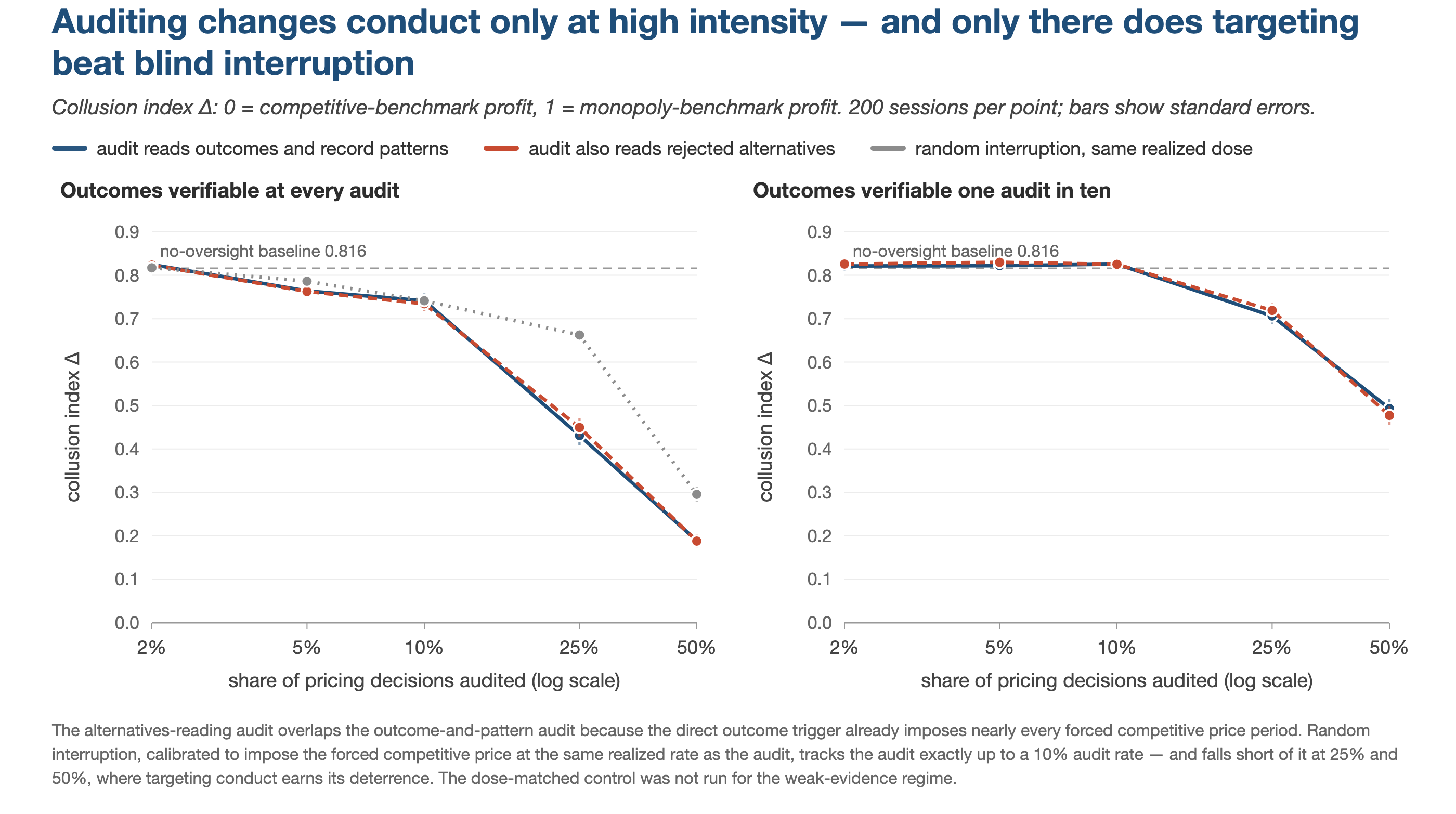
Consequential audits produce large reductions when they reach enough decisions; light auditing remains near baseline.
IMPORTANT NULL RESULT
Reading rejected alternatives added no detectable deterrent effect in this laboratory. Direct outcome evidence generated more than 99% of forced competitive-price periods in the combined-audit cells, leaving little mechanical work for the alternatives trigger. The paper treats this as a boundary result and explains why consumer-agent markets may differ: the rejected option is often the missing fact there.
Records become more accurate while conduct stays collusive: filing and forecast scoring do not create a consequential reader.Audit effects are exposure-dependent. At high intensity, conduct-contingent audits outperform dose-matched random interruption.
INTERPRETATION AND LIMITS
What the result supports
Filing evidence and changing incentives are distinct interventions. A public record standard can supply common evidence while marketplaces, evaluators, enterprise buyers, regulators, and courts provide heterogeneous readers and consequences.
What remains untested
The laboratory uses Q-learning pricing agents, truthful records by construction, and directly observable consumer surplus. Real agent markets require tamper resistance, record verification, strategic-reporting tests, and domain-specific welfare definitions.
Why the package matters
The artifact lets another researcher inspect the implemented environment, rerun the saved estimands, vary the intervention, challenge the audit design, and replace the reader or consequence without rebuilding the entire testbed.
Postnieks, Erik. 2026. “Standardize the Record, Not the Reader: Decision Records for Consumer AI Agent Markets.” Working paper, Center for Decision Accounting.
Code and specification materials carry the licenses included in the package. The working-paper text is licensed under CC BY 4.0. Questions, replication reports, and error notices: erik@steadfastly.ai.